Bandwidth Allocation Techniques for Sustaining Multi-Platform Broadcasts Amid Variable Network Conditions
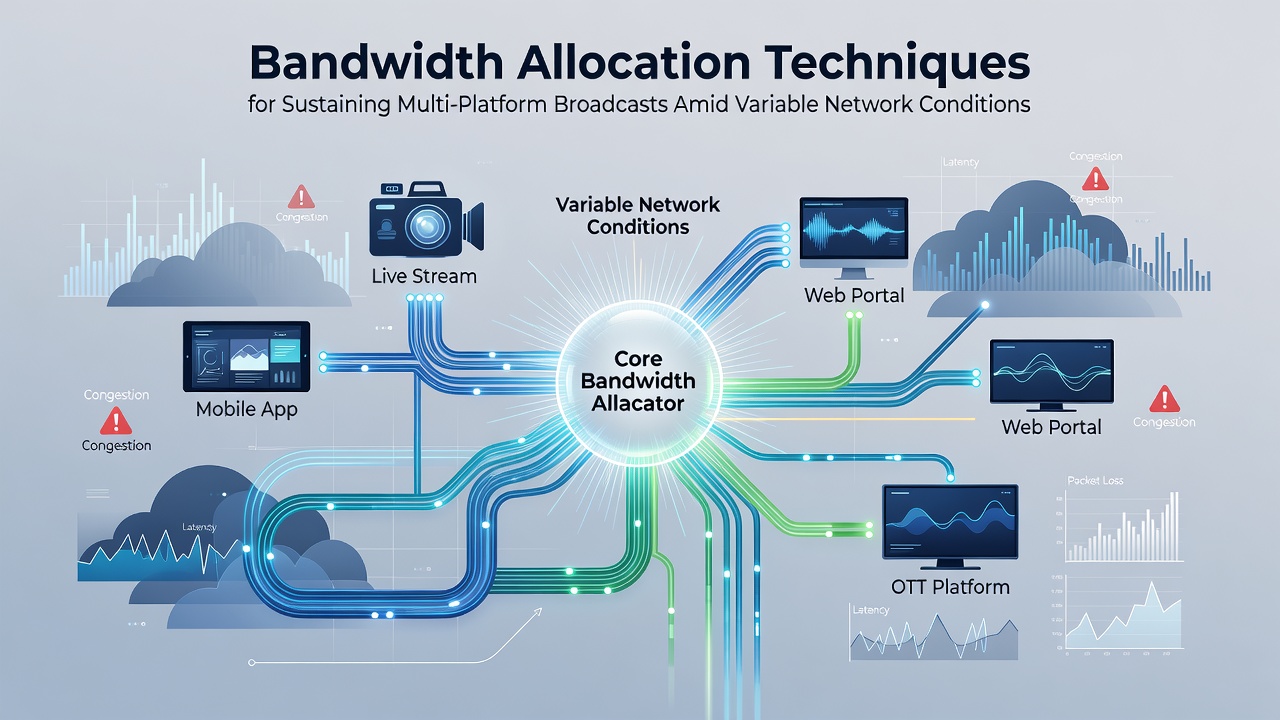
Multi-platform broadcasts require precise bandwidth management because network conditions shift constantly due to congestion, packet loss, and interference from competing traffic, and techniques that allocate resources dynamically allow simultaneous streams to Twitch, YouTube, and other services without interruption. Researchers have documented how fixed allocation leads to dropped frames or degraded quality when upstream capacity dips below expected levels, whereas adaptive methods respond in real time by reallocating bits across platforms based on measured throughput.
Core Challenges in Variable Networks
Variable network conditions create uneven paths for data packets, and studies from regulatory bodies show that residential connections experience fluctuations of 20 to 40 percent during peak evening hours. Multi-platform setups compound this because each endpoint demands its own sustained bitrate, and a single bottleneck can cascade into quality loss across all destinations. Observers note that platforms differ in their tolerance for latency and jitter, so allocation must account for these variances rather than treating every stream identically.
Adaptive Bitrate and Dynamic Scaling
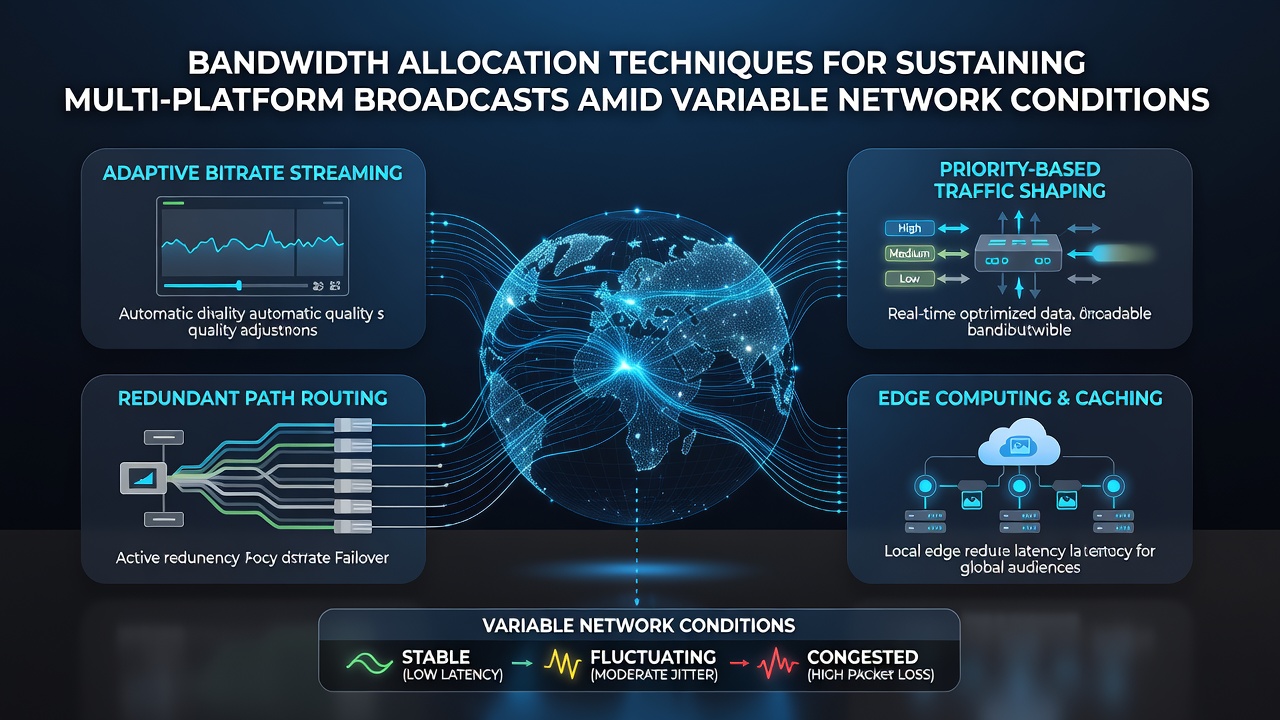
Adaptive bitrate streaming adjusts encoding parameters on the fly, and data from network monitoring tools indicate that encoders can switch between preset ladders within 2 to 5 seconds of detecting throughput changes. In multi-platform scenarios this means one stream might drop from 1080p60 to 720p30 while another maintains higher resolution if its target service reports better conditions. The approach relies on continuous feedback loops that measure available bandwidth per destination and then redistribute encoder resources accordingly.
Prioritization Protocols
Priority queues assign higher transmission precedence to primary platforms during constrained periods, and figures from industry reports reveal that weighted fair queuing reduces frame drops on high-value streams by up to 35 percent. Administrators configure rules that favor the platform with larger concurrent viewership while throttling secondary outputs only when total capacity falls below combined requirements. This method integrates with existing router firmware and does not require custom hardware in most cases.
Redundancy Through Multi-Path Routing
Multi-path routing spreads traffic across separate internet connections or virtual tunnels, and evidence collected by the Canadian Radio-television and Telecommunications Commission demonstrates improved stability when broadcasters combine fiber with 5G backup links. When primary bandwidth contracts, packets reroute automatically without encoder intervention, maintaining continuity for all platforms. Implementation often involves software-defined networking controllers that monitor each path's latency and packet-loss metrics before deciding which route carries which stream segment.
Buffer Management and Predictive Allocation
Buffer sizing plays a central role because oversized buffers introduce delay while undersized ones cause underruns during brief dips. Researchers at several universities have modeled algorithms that predict congestion windows using historical traffic patterns collected over weeks, allowing preemptive reduction of aggregate bitrate before actual packet loss occurs. In June 2026 updated models incorporated machine-learning forecasts trained on larger datasets, resulting in allocation decisions that anticipate changes 10 to 15 seconds ahead rather than reacting after they appear.
Integration With Content Delivery Networks
Content delivery networks provide edge servers that absorb some variability through localized caching and transcoding, and reports from the Australian Communications and Media Authority highlight how edge-assisted allocation lowers upstream demand from the broadcaster's location. When local conditions degrade, the origin server reduces resolution for certain platforms while edge nodes continue serving cached segments at higher quality to viewers. This hybrid model shifts part of the allocation burden away from the variable last-mile link.
Monitoring and Feedback Mechanisms
Real-time telemetry feeds supply the data required for allocation engines, and continuous collection of round-trip times plus throughput samples enables rapid recalculation of bit budgets. Systems that poll every 500 milliseconds catch transient congestion faster than those relying on longer intervals, and operators combine these metrics with platform-specific APIs that report viewer-side buffer health. The resulting closed-loop control keeps aggregate usage within available capacity while preserving acceptable quality across destinations.
Conclusion
Bandwidth allocation for multi-platform broadcasts succeeds when techniques combine adaptive encoding, prioritization, multi-path routing, predictive modeling, and edge assistance into a coordinated system that reacts to measured conditions. Data collected through 2026 confirms that such integrated approaches sustain simultaneous streams more reliably than static configurations, particularly when upstream networks exhibit the variability common in consumer and small-business environments.